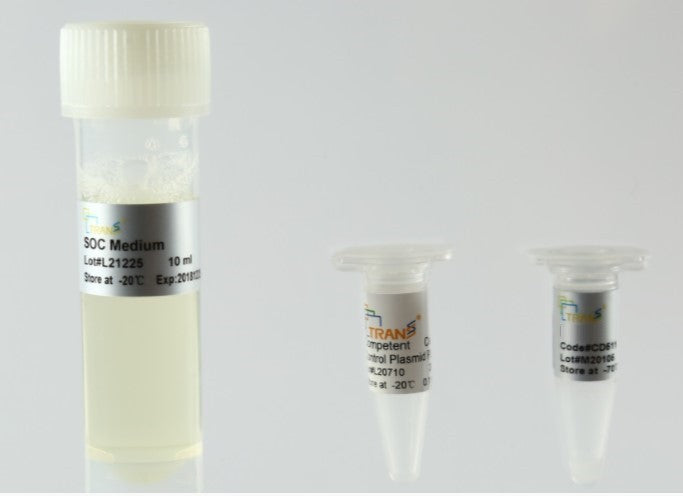
Trans109 Chemically Competent Cell
Trans109 Chemically Competent Cell
SKU:CD301-20
Couldn't load pickup availability
Supplied in 2 x 50μl reactions per vial; 100μl per vial.
20 reaction size is delivered in 10 vials; 40 reaction size is delivered in 20 vials.
|
Genotype |
endA1 recA1 gyrA96 thi-1 hsdR17 (rk-, mk+) relA1 supE44 D (lac-proAB) [F′traD36 proAB laqIqZΔM15]
|
|
Features |
• High transformation efficiency: >108 cfu/μg ( pUC19 DNA). • The lowest homologous recombination favorable for plasmid DNA preparation. • Routine cloning. • Blue/white selection.
|
|
Storge |
at -70 °C for six months
|
|
Notes |
Higher efficiency transformation can be achieved by transforming cells immediately following thawing. Avoid repeated thawing. Gentle handling is required for the entire procedure. |
References:
•
| Literature | Journal | IF | Author | Date | Link |
|---|---|---|---|---|---|
| MAPK signaling pathway alters expression of midgut ALP and ABCC genes and causes resistance to Bacillus thuringiensis Cry1Ac toxin in diamondback moth | PLoS Genetics | 8.167 | Zhaojiang Guo?? et al | 2015 Apr | The original link |
| Bacillus thuringiensis subsp. sichuansis strain MC28 produces a novel crystal protein with activity against Culex quinquefasciatus larvae | World Journal of Microbiology and Biotechnology | 1.262 | Peng Guan, et al. State Key Laboratory of Hybrid R | 2014 Apr | The original link |
| Cloning and characterisation of a novel cry1H gene effective against lepidopterous larvae from a Bacillus thuringiensis strain | Biocontrol Science and Technology | 0.848 | Yu Z, et al. Sichuan agricultural university | 2015 | The original link |
LiteratureJournalIFAuthorDateLinkDown-regulation of a novel ABC transporter gene (Pxwhite) is associated with Cry1Ac resistance in the diamondback moth, Plutella xylostella (L.)Insect Biochemistry and Molecular Biology3.42Zhaojiang Guo?? et al2015 JanThe original linkCloning, expression, and characterization of a novel xylose reductase from Rhizopus oryzaeJournal of Basic Microbiology1.823M Zhang, et al.2015 FebThe original linkProduction of poly(3-hydroxypropionate) and poly(3-hydroxybutyrate-co-3-hydroxypropionate) from glucose by engineering Escherichia coli0De-Chuan Meng, et al.2015 AprThe original link